CipherWord Master
- 4.5
- Rating
- 50.00K
- Installs
- Free
- Price

 Analysis by App-foxy
Some word games are built around speed, while others reward a large vocabulary or careful deduction. CipherWord Master takes a more focused route: it turns word solving into a challenge of recognizing and decoding patterns. I found that this central idea gives the game a distinct rhythm. Instead of simply searching for letters, I had to pause, test relationships, and decide whether a promising guess actually fitted the puzzle.
That makes it a good fit for short sessions when I want something more involving than a casual tap game but less demanding than a long strategy title. It is a free word game from Word Puzzle Lab, rated for Everyone, and its current version is 1.2.0. The game has an average rating of 4.5 from around 393 ratings, with over 50K installs, so it has already attracted a modest audience without feeling like an overcrowded mainstream franchise.
Why the cipher-based word challenge matters
The most important capability here is the way the game asks me to interpret words rather than merely recognize them. That difference sounds small, but it changes how I play. In a conventional word search, I can often scan quickly and rely on familiar combinations. With a cipher-style puzzle, I need to consider what the visible information is trying to represent and how one clue may affect the meaning of another.
You May Also Like

 Blood Strike: 2.5 Anniversary
Blood Strike’s Loadouts Turn Every Drop Into a Tactical Gamble
A close look at Blood Strike’s custom loadouts: how fast access to signature weapons reshapes its battle royale rhythm, rewards preparation, and narrows the gap between fights.

 Pandora - Music & Podcasts
Pandora’s Music Is Easy to Start, but Harder to Recover
Pandora’s strength is its low-effort path from a seed to a station. Its weak spot is how much confidence it asks you to place in connection, setup, and quiet recovery.

 8 Ball Pool
 Is Built on Rivalries, Rematches, and Routine
A close look at the rivalries, rematches, shared routines, and unanswered safety questions that turn a quick pool match into a persistent mobile community.

 Samsung Music
’s Quiet Strength Is Playing What You Already Own
Its reach comes less from spectacle than from dependable access to a personal library. That simplicity is both the app’s strongest retention engine and its ceiling.

 AccuWeather: Weather Radar
AccuWeather Review: A Quick, Clear Forecast for Everyday Decisions
For everyday plans, the best forecast is the one you can understand quickly. AccuWeather makes rain timing, radar, and local conditions easy to act on, with a few trade-offs.

 Hill Climb Racing
Why Hill Climb Racing Still Turns Crashes Into One More Run
A tiny car, a bumpy hill and one more upgrade: Hill Climb Racing keeps resurfacing because its simple chaos makes every near-miss feel personal.
More From Our News Desk
View All News


I especially liked the extra pause this creates. A difficult puzzle does not always feel difficult because the vocabulary is obscure. Sometimes the challenge comes from approaching the clue with the wrong assumption. When that happened, the useful move was not to guess faster. It was to step back, look for a repeated pattern, and ask what kind of word relationship the puzzle expected me to notice.
The real strength is the change in thinking, not simply the presence of word clues. CipherWord Master encourages a measured solving process. That makes each successful answer feel more earned than a lucky swipe through a familiar word list. It also gives the game a small learning curve: players who usually depend on instant recognition may need time to become comfortable with its logic.
This focus separates it from ordinary crossword apps, anagrams, and word searches. Those formats can be excellent when I want a relaxed vocabulary exercise, but they often make the basic action obvious from the start. Here, the main task is understanding the puzzle’s internal signal before committing to an answer. That is the feature I would use to decide whether the game belongs on your phone.
Reading the puzzle instead of rushing the answer
In practice, I found it helpful to divide each challenge into two stages. First, I looked for the structure: repeated symbols, familiar fragments, possible word lengths, or any relationship between the visible pieces. Second, I tested possible answers against that structure. Keeping those stages separate prevented me from becoming attached to the first word that came to mind.
That approach is more useful than trying to solve by instinct alone. If an answer seems plausible but does not explain the whole pattern, I treat it as a temporary hypothesis rather than a solution. This habit also reduces the frustration that can come from repeatedly entering near-misses. The game rewards careful interpretation, so random guessing is usually a poor substitute for examining the clue again.
My practical tip is to keep a small mental record of what a symbol or pattern appears to do before using it in a new guess. A repeated element may not be decorative; it can become a key to understanding the rest of the puzzle. I also found it worthwhile to revisit the full clue after forming a possible answer. Looking only at the most obvious section can make a nearly correct guess feel more convincing than it really is.
This is where the game can become surprisingly absorbing. A puzzle may look simple at first, then reveal that the obvious interpretation leaves one detail unexplained. That final inconsistency is often the reason to keep working. I enjoyed those moments because they turned the experience into a compact reasoning exercise rather than a vocabulary test.
A realistic everyday session
The best everyday use case is a short break in which I want concentration without a large time commitment. Imagine waiting for an appointment or taking a quiet pause after lunch. I can open the game, work through a puzzle at my own pace, and stop after reaching a natural point. The cipher format gives the session enough mental substance to feel worthwhile, while the word-game format keeps it approachable.
I would not choose it when I need something completely mindless. If I am tired and only want to match colors or watch a simple progress loop, this kind of puzzle may ask for more attention than I want to give. Its value comes from engaging the part of my brain that compares possibilities and notices structure. That is useful during a break, but it is not the same as passive entertainment.
It can also work well as a personal vocabulary routine, although I would describe it more accurately as a reasoning routine with words at its center. I used the puzzles to practice slowing down before answering. That skill transfers better to other deduction games than to ordinary spelling drills. Players who enjoy noticing patterns may find the format naturally satisfying, even when they do not consider themselves word-game experts.
For a shared setting, I would treat it as a discussion game rather than a competitive party game. Showing another person a puzzle and comparing interpretations can make the solving process more interesting. However, the experience depends on the individual player’s willingness to think through the clue, so it is less suitable for a noisy group that wants immediate, simultaneous action.
Where the experience asks for patience
The same quality that makes the game distinctive can also create friction. When I understand the intended pattern, the challenge feels clever. When I do not, progress can slow sharply because the obstacle is not always a missing word; it may be a misunderstanding of the puzzle’s language. That distinction matters. Players who prefer transparent instructions and instantly readable objectives may find the experience less comfortable than a standard word search.
There is also a trade-off between accessibility and depth. A familiar anagram usually tells me exactly what kind of manipulation to perform. A cipher-oriented puzzle can be more rewarding, but it may require experimentation before the rules become intuitive. I recommend giving it a fair trial rather than judging it after the first confusing challenge. At the same time, I would not tell everyone to persist indefinitely: if interpreting the format feels like work instead of play, another word game may be a better choice.
The free entry point is helpful, especially for deciding whether this style suits you. The game does include in-app purchases ranging from $0.99 to $99.99 per item. I would approach those options carefully and decide first whether the core solving loop has become part of my routine. A purchase can make sense for someone who plays regularly and wants to support continued use, but occasional players should not feel pressure to spend simply because they encounter a difficult puzzle.
Because the game is aimed at Everyone, it is easy to consider for a broad household audience. Still, an age label does not guarantee that every player will find the reasoning level comfortable. Younger players may enjoy the discovery aspect, while others may need time to understand how to interpret the clues. I would introduce it as a puzzle to explore together rather than assume that the rating tells me how challenging it will feel.
Tips that make solving less frustrating
My first useful habit is to avoid changing several assumptions at once. If I think a particular pattern represents a letter group, I test that idea against the rest of the puzzle before inventing a completely different explanation. This keeps the solving process organized and makes it easier to notice exactly where an interpretation breaks down.
Second, I try to separate a word I recognize from a word that genuinely fits. A familiar answer can be tempting because it arrives quickly, but the better answer is the one that accounts for the puzzle’s full structure. This is a small distinction, yet it prevents many wasted guesses. In my experience, the game becomes more satisfying when I treat each answer as something to justify rather than something to hope for.
Third, I use a reset in attention when I feel stuck. Instead of staring at the same symbol arrangement, I read the puzzle from the beginning and describe its visible parts in plain language. That simple change often exposes an assumption I had made without noticing. It is a practical technique for this game because the main barrier is frequently interpretation, not a lack of vocabulary.
Finally, I avoid playing several difficult puzzles while distracted. The game benefits from a few uninterrupted minutes, even if the overall session is short. Notifications, conversation, or multitasking can make a manageable clue seem unnecessarily obscure. If I only have a moment, I prefer solving one puzzle carefully rather than opening the game repeatedly and guessing without focus.
How it compares with familiar word games
Compared with word searches, CipherWord Master feels less visual and more analytical. A word search rewards scanning and recognition, while this game asks me to infer what the displayed information means. If I enjoy finding hidden words quickly, the traditional format may be more relaxing. If I prefer decoding a relationship and checking whether a solution is logically complete, this game has the stronger appeal.
Compared with anagram games, it is less dependent on rearranging a known collection of letters. Anagrams are often satisfying because the target word is buried in plain sight. Here, the challenge comes earlier: I first need to understand the clue’s mechanism. That gives the game more interpretive depth, but it also means the payoff may take longer to arrive.
Crossword apps remain a better choice for players who want broad clues, intersecting answers, and a familiar newspaper-style structure. CipherWord Master is narrower and more focused. Its appeal is not the variety of a large crossword grid; it is the repeated act of decoding a compact word puzzle. I would choose between them based on mood: crosswords for expansive clue solving, this game for a concentrated pattern challenge.
It also differs from fast daily word games that encourage a quick attempt and a clear result. Those titles can fit neatly into a routine because their rules are immediately visible. This one is better when I want the solving process itself to occupy my attention. The trade-off is simple: less instant clarity, more room for a satisfying breakthrough.
Who will get the most from it
I think the strongest audience is made up of players who enjoy word puzzles but want something beyond spelling, matching, or speed. People who naturally ask “what is the rule here?” will probably connect with the cipher approach. It is also a good option for anyone looking for a quiet mental exercise that can be played in short sessions without requiring a large game world or a complicated control scheme.
It may suit students and language learners as a supplementary activity, but I would not present it as a formal teaching tool. The value I found is in flexible thinking, attention to patterns, and resisting premature answers. Those are useful skills, yet the game’s purpose is entertainment first. Players looking for structured lessons, detailed progress tracking, or a full vocabulary course should look elsewhere.
I would skip it if my ideal word game is completely effortless or if I dislike puzzles that can remain unclear until I reconsider the premise. I would also choose a conventional crossword or anagram title when I want a more familiar rule set. The game is not trying to replace every word format; its appeal depends on whether decoding feels enjoyable to you.
For families, the Everyone rating makes it a reasonable candidate to try together, but I would let each player set the pace. One person may see the pattern immediately while another needs to talk it through. That difference can be part of the fun, provided nobody treats a slower solution as a failure. The game works best when curiosity matters more than speed.
Word Puzzle Lab has made a focused game rather than a broad collection of unrelated modes. That focus is both its identity and its limitation. I came away appreciating how a single verified capability—decoding word patterns—can create a different kind of puzzle routine when the player gives it time.
As a free download released on Jul 18, 2024, it is easy to try without making a commitment. The minimum operating system is Android 7.0, and the current version remains 1.2.0. Those details make it accessible to many Android users, while the optional purchases are worth considering only after deciding whether the central challenge genuinely holds your interest.
My final recommendation is selective but positive. CipherWord Master is worth trying if you want a word game that rewards interpretation, patience, and careful checking. I would not recommend it to someone seeking rapid, automatic play, but for a reader who enjoys the moment when a confusing pattern suddenly makes sense, it offers a distinctive and worthwhile break.
FAQs for CipherWord Master
01What is CipherWord Master and how does the game work?
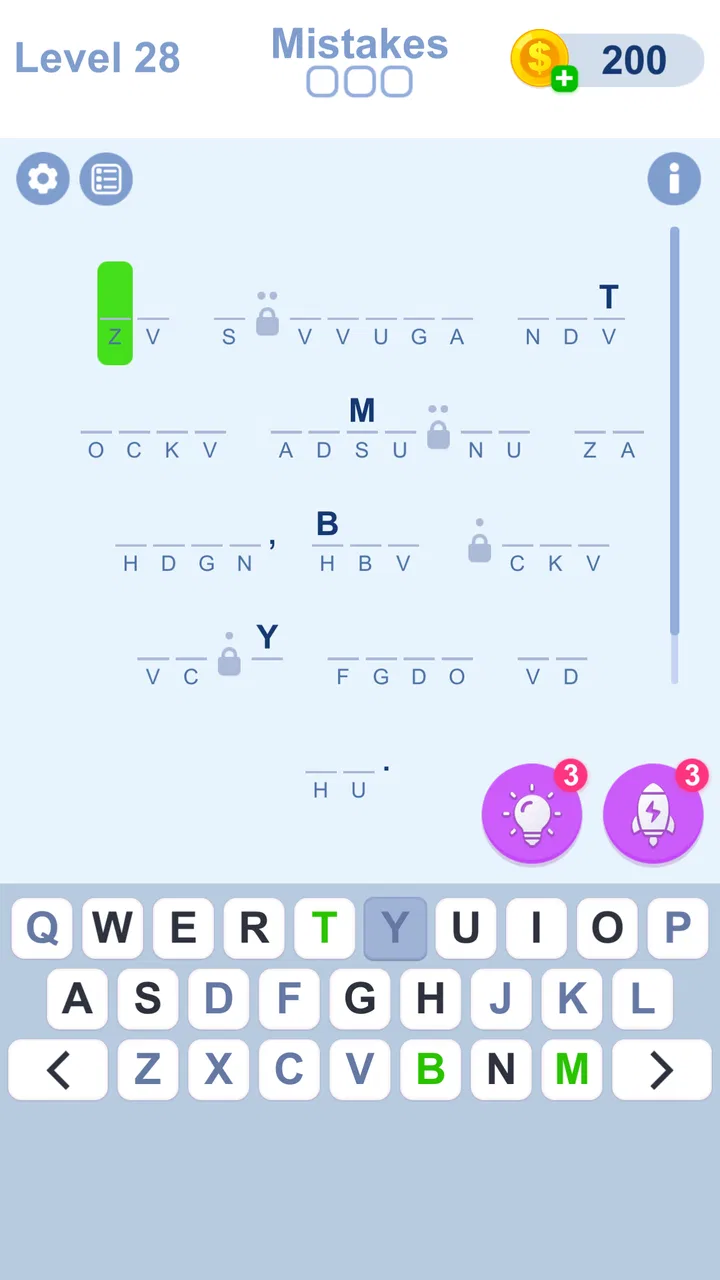
CipherWord Master is a word puzzle game built around decoding encrypted words and solving letter-based challenges. During testing, the core gameplay felt easy to understand: you study the available clues, identify patterns, and rearrange or interpret letters to reveal the hidden answer. Each completed puzzle helps you progress through increasingly demanding stages, making it suitable for both casual sessions and players who enjoy testing their vocabulary and logic skills.
02Is CipherWord Master suitable for beginners?
Yes, CipherWord Master is generally approachable for beginners, especially if you enjoy crossword-style games, anagrams, or simple code-breaking puzzles. The early challenges are designed to introduce the game’s mechanics without overwhelming new players. However, later levels may require stronger vocabulary, careful attention to clues, and patience. If you become stuck, using hints can help, although the availability or cost of those hints may depend on the game’s current system.
03Can I play CipherWord Master offline?
CipherWord Master may allow some puzzle content to be played without a continuous internet connection, which is useful when traveling or playing in areas with limited reception. Nevertheless, certain features can still require online access, including advertisements, cloud synchronization, updates, leaderboards, or in-app purchases. Before relying on it for completely offline entertainment, it is best to test the game after disabling your connection and check the store listing for the latest requirements.
04Does CipherWord Master contain advertisements or in-app purchases?
Like many free-to-download puzzle games, CipherWord Master may include advertising and optional in-app purchases. Ads can appear between levels or when you request additional hints, while purchases may provide coins, remove advertisements, or unlock helpful resources. You can normally enjoy the basic game without paying, but players who want uninterrupted sessions or faster assistance should review the pricing, subscription details, and purchase conditions shown on the Android or iOS store page.
05What should I check before downloading CipherWord Master?
Before downloading CipherWord Master, check that your device meets the required operating-system version and has enough free storage for the installation and future updates. You should also review the app’s permissions, privacy information, advertising policy, and recent user feedback. Because puzzle difficulty and monetization preferences vary, confirm whether the game supports your preferred language, offers enough content, and provides the offline or accessibility features you expect.
Pros
- Offline play lets you enjoy puzzles without a constant internet connection.
- Clean interface makes the word challenges easy to understand and navigate.
- Gradual difficulty provides a comfortable learning curve for casual players.
- Short rounds fit well into commutes or quick gaming breaks.
- Helpful hints can prevent frustrating dead ends during tougher puzzles.
Cons
- Repeated puzzle patterns may reduce the challenge for experienced word gamers.
- Some advanced content may require in-app purchases or additional unlocks.
- Small screens can make longer words harder to review at a glance.
- Hint systems may feel limited when you are stuck on particularly obscure words.
- Progress could feel slow if you prefer fast-paced or highly competitive games.

CipherWord Master
Gallery